

Last Sunday, a gentleman at the fish market looked at a hilsa, smiled sadly and asked:
“Dada, aar ektu kom hobe na?”
The fish seller shook his head.
“Ei daam-e etai.”
This everyday exchange has become increasingly common in Kolkata’s fish markets as many families struggle with rising fish prices.
A customer looks at the fish, asks the price, calculates the household budget and quietly moves towards a smaller one—or leaves without buying anything.
This feels strange in Bengal.

We live in a land of rivers, wetlands, ponds, estuaries and coastal waters. West Bengal also has direct access to the Bay of Bengal. Fish is not an occasional food here. It is part of everyday cooking, festivals, family memories and cultural identity.
So why are ordinary families finding many familiar fish increasingly expensive?
Why has hilsa become a luxury for so many people? Why are several sea fish costly even during their season? And why do some varieties seem less common in neighbourhood markets than people remember?
The answer may not be lying on the fish seller’s table.
The real story may begin much earlier—in a river, an estuary, a coastal breeding ground, a fishing harbour or somewhere in the Bay of Bengal.
The answer may not be lying on the fish seller’s table.
Bengal Has Water Everywhere—So What Is Going Wrong?
Bengal’s relationship with fish begins with geography.
The state is crossed by rivers and tributaries. It has ponds, wetlands, canals, tidal creeks, estuaries and the mangrove landscape of the Sundarbans. It also has a coastline of roughly 160 kilometres along the Bay of Bengal.
For generations, these waters supported fishing communities and supplied homes and markets with freshwater, estuarine and marine fish.
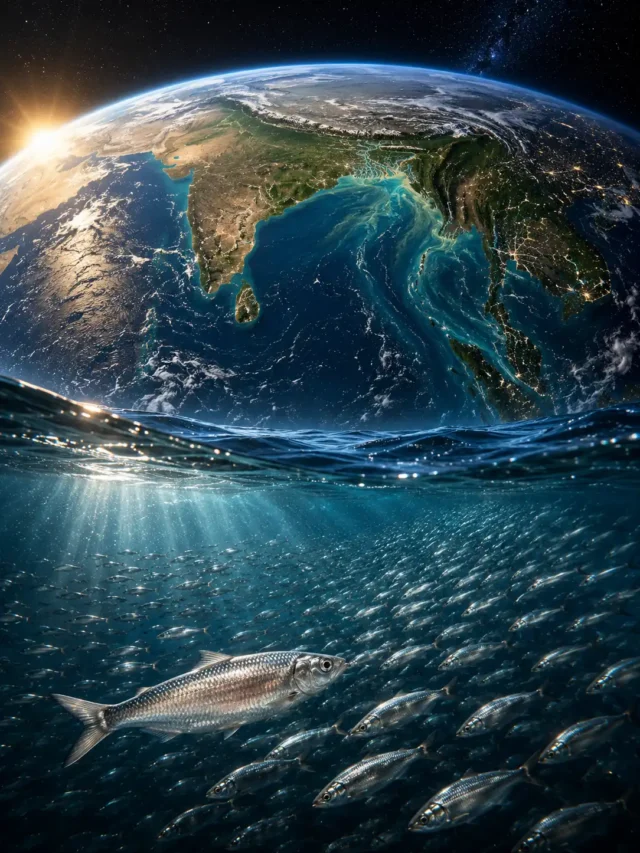
Fish slowly became part of almost every layer of Bengali life.
It entered wedding customs, seasonal cooking, religious offerings, family celebrations, proverbs and literature. A particular fish could remind someone of a district, a season, a grandmother’s kitchen or a childhood meal.
That is why today’s prices surprise people.
A region surrounded by so much water should, at least in our imagination, have plenty of affordable fish.
But geography alone cannot guarantee abundance.
Rivers can become polluted. Wetlands can disappear. Breeding grounds can be damaged. Fishing can increase. Fuel and transport costs can rise. Demand can grow faster than supply.
Water may still be visible everywhere, while the life inside that water quietly changes.
Why Are Fish Prices in Kolkata Rising?
There is no single reason behind every rise in fish prices.
Sometimes the explanation is simple. Bad weather may keep fishing boats ashore. A cyclone warning may reduce supply. A seasonal fishing ban may temporarily limit the catch. Fuel prices and transport costs may increase.
Festival demand can also push up prices. When thousands of families want the same fish at the same time, sellers know that customers are willing to pay more.
But these short-term explanations do not answer everything.
When people repeatedly notice higher prices, smaller fish, fewer choices or the irregular appearance of familiar varieties, a bigger question begins to form.
Is the problem only in the market?
Or is the market showing us the result of something happening much farther away?
The Price Tag Has a Long History
Before a fish reaches a customer, many costs have already been added.
- The cost of the fishing boat and fuel
- The cost of nets, labour and ice
- The amount of fish caught on that trip
- The auction price at the landing centre
- Storage and cold-chain expenses
- Transport to wholesale markets
- Wholesale and retail margins
- Seasonal and festival demand
If the catch is poor, each fish may become more expensive.
If fuel costs rise, the price may rise again.
If demand is high and supply is limited, the customer pays even more.
The price we see in Kolkata is the final result of many decisions, risks and costs that came before it.
We Keep Hearing One Explanation
Whenever fish become scarce, one explanation is repeated again and again: illegal nets, juvenile fishing and the breaking of seasonal fishing rules.
These are genuine concerns.
If very young fish are caught before they reproduce, future fish populations may suffer. If fishing continues during breeding or migration periods, vulnerable fish may face additional pressure.
Rules about net size, fishing seasons and protected areas exist for a reason. They must be enforced properly.
But should the entire problem be explained through one kind of net or one group of fishers?
That may be too easy.
Fish move through connected waters. Fishing happens at different scales. Pollution, river flow, breeding grounds, market demand and commercial technology may all influence what finally reaches Kolkata.
Illegal fishing may be part of the story. It may not be the whole story.
The Story Begins Before the Fish Reaches Kolkata
We often think about fish only after it appears on a market stall.
But every fish has already passed through an ecosystem before entering a supply chain.
Some fish spend their lives in freshwater. Some live in the sea. Others move between marine water, estuaries and rivers.
Hilsa is the most familiar example.
Hilsa spends much of its life in the sea and enters rivers to breed. Its journey may depend on conditions in marine waters, river mouths, estuaries and freshwater migration routes.
This means that looking only at one river may not tell us the full story.
A Fish Does Not Recognise Our Boundaries
A fish may move through different districts, states or even waters shared by different countries.
It does not know where one administrative boundary ends and another begins.
If a migratory fish faces heavy fishing pressure before entering Bengal’s rivers, fewer may arrive upstream.
If an estuary is polluted or a breeding ground is damaged, the effect may later appear in a market far away.
Rivers, estuaries and the sea therefore cannot always be treated as separate worlds.
How Does a Fish Reach Your Local Market?
A fish bought in Gariahat, Maniktala, Lake Market or a neighbourhood bazaar may have travelled through many hands.
- It is caught in a river, estuary, coastal zone or marine fishing ground.
- It is brought back by a small boat or commercial fishing vessel.
- It reaches a landing centre or fishing harbour.
- It is sorted and sold through an auction.
- It is packed with ice or placed in cold storage.
- It travels to a wholesale market.
- Retailers buy it and carry it to local markets.
- The customer finally sees it on the seller’s table.
At every stage, something may change.
The fish may lose freshness. Transport may be delayed. Ice may be insufficient. Fuel costs may rise. A wholesaler may pay more at auction. A retailer may have to cover unsold stock.
This is why an expensive fish does not automatically mean that the fisher who caught it has earned a large profit.
Between the sea and the dinner plate lies an entire economy.
Has Modern Fishing Become Too Efficient?
Fishing today is very different from the fishing many older people remember.
Traditional knowledge is still important, but modern vessels may also use powerful engines, satellite navigation, sonar and electronic fish-finding equipment.
These tools can help crews locate fishing grounds more quickly. They can improve navigation, reduce uncertainty and help boats return safely.
Technology itself is not the enemy.
The concern begins when more powerful technology allows fish to be found and caught faster than populations can recover.
The Real Question Is Not Technology Versus Tradition
It would be unfair to say that fishers should reject modern safety and navigation tools.
The important questions are different:
- How much fishing is taking place?
- Which species are being targeted?
- Are juvenile fish being caught?
- Are breeding seasons being respected?
- Do authorities have reliable catch data?
- Can fish populations replace what is being removed?
Better fishing technology must be matched by better monitoring and better protection.
What Else Gets Caught in the Net?
A fishing net does not always catch only the fish that a boat is looking for.
Juvenile fish, small non-target species, turtles and other aquatic animals may also become trapped.
This is known as bycatch.
The amount of bycatch depends on the kind of net, the fishing method, the season and the location.
Some methods are more selective. Others may collect many different forms of marine life together.
Why Should an Ordinary Customer Care?
Because an unwanted catch is not always harmless.
A juvenile fish caught today will never grow into the larger fish that could have reached the market later.
Removing too many small or non-target species may also disturb the food chain on which larger fish depend.
What disappears from the sea today may disappear from the market tomorrow.
Can a River Become Too Sick to Feed Us?
A river may look full of water and still be unhealthy.
Sewage, industrial waste, agricultural runoff and plastic pollution can reduce water quality and damage aquatic life.
Fish do not live alone. They depend on plankton, insects, plants, oxygen, suitable temperature and safe breeding grounds.
When the smaller parts of the ecosystem are damaged, fish populations may also suffer.
What Happens When River Flow Changes?
Dams and barrages can change how much water moves through a river and when that water arrives.
They may also create barriers for migratory fish.
Changes in freshwater flow can affect estuarine salinity, sediment movement and the conditions needed for breeding and migration.
What Happens When Wetlands Disappear?
Wetlands, mangroves and estuaries often act as nurseries for young fish and crustaceans.
When these areas are filled, polluted or disturbed, the effect may not be visible immediately.
Years later, the loss may appear as fewer fish, smaller catches and higher prices.
Who Really Earns From the Fish We Buy?
A customer may pay a high price and assume that the fisher must also be earning well.
That is not always true.
Small-scale fishers may face the cost of fuel, boat repair, nets, ice, labour and loans. They also face uncertain weather and the possibility of returning with a poor catch.
After the fish is landed, auction agents, transporters, wholesalers and retailers all become part of the chain.
Each of them has costs and margins.
This leads to a question that is rarely discussed in the neighbourhood market:
When fish becomes expensive, who receives the greatest benefit—and who carries the greatest risk?
Local Demand and Export Demand
Bengal has a large population of fish-eating consumers. Restaurants, hotels, festivals and urban households create strong demand.
Some fish and seafood products are also valuable in markets outside the state and outside India.
Export can create jobs and income. But it may also influence which species are targeted and where the best-quality catch is sold.
The question is not whether trade should stop.
The question is whether local supply, fisher livelihoods and conservation are being balanced properly.
This Is Not Only a Hilsa Story
Hilsa receives the most attention because of its cultural importance.
During the monsoon and festival seasons, its price becomes a topic of conversation in homes, markets and newspapers.
But Bengal’s fisheries story is much larger than hilsa.
Kolkata’s markets sell many freshwater, estuarine and marine varieties, including:
- Bhetki
- Parshe
- Pomfret
- Bhola
- Loitta or Bombay duck
- Prawns
- Crabs
- Small indigenous freshwater fish
When several types of fish become costly or irregular, the problem cannot be understood by looking at hilsa alone.
We must look at rivers, wetlands, estuaries, coastal waters, fishing methods, transport, demand and the market system together.
The Questions We Should Be Asking
Before blaming one person or accepting one easy explanation, Bengal needs to ask wider questions.
- Are fish populations in the Bay of Bengal healthy?
- How much fishing takes place before fish approach Bengal’s rivers and coast?
- Are juvenile fish being caught before they have a chance to reproduce?
- How much unwanted catch is produced by different kinds of fishing nets?
- Are breeding and migration seasons being protected properly?
- How are sonar, navigation systems and fish-finding equipment being used?
- How badly are sewage and industrial pollution affecting rivers and estuaries?
- Have dams and barrages changed the routes used by migratory fish?
- How many wetlands and nursery habitats have been lost?
- How much does rising domestic demand affect price and availability?
- Does export demand reduce the quantity or quality available locally?
- How much of the final price reaches the fisher who took the original risk?
- Do policymakers have enough reliable and publicly available fisheries data?
- Are rivers, estuaries and offshore waters being protected as one connected system?
These questions do not have simple answers.
But asking them is better than repeating a conclusion before the evidence has been examined.
What Kind of Fish Market Will the Next Generation See?
Fish is more than food in Bengal.
It carries memories of family kitchens, monsoon meals, market mornings, festivals and regional traditions.
But memory alone cannot protect fish populations.
Protection requires clean rivers, healthy wetlands, safe breeding grounds, responsible fishing, reliable data and fair enforcement.
It also requires consumers to understand that the fish seller is only the last person in a very long story.
Questions Before Conclusions
This article does not claim that one single cause is responsible for every change in Kolkata’s fish markets.
Some causes may already be supported by scientific research. Other questions require field reporting, local data and discussion with fishers, traders, scientists and policymakers.
The purpose is to widen the conversation.
If Bengal has rivers, wetlands, estuaries and access to the Bay of Bengal, why are many ordinary families paying so much for fish?
Why are some familiar varieties becoming harder to find?
Where does the shortage really begin?
And what must be protected today so that Bengal’s fish culture does not become only a memory tomorrow?
Kolkata’s fish markets tell the final chapter. The full story begins much farther away—in rivers, wetlands, estuaries, fishing grounds and the Bay of Bengal.
Frequently Asked Questions
Why are fish prices increasing in Kolkata?
Fish prices may rise because of poor catches, seasonal shortages, bad weather, fuel costs, transport expenses, storage costs, strong demand and changes in the wider fish supply chain.
Is overfishing the only reason fish are becoming scarce?
No. Fishing pressure may be one cause, but pollution, loss of breeding grounds, changing river flow, unwanted catch, market demand and supply-chain costs may also play a role.
Why is hilsa so expensive?
Hilsa prices are affected by seasonal availability, migration, catch size, fishing restrictions, demand, transport and the health of marine, estuarine and river habitats.
How does river pollution affect fish?
Pollution can reduce water quality, damage breeding grounds and harm the plants and small aquatic organisms on which fish depend.
What is bycatch?
Bycatch means fish and other aquatic animals that are caught accidentally while fishing for a different target species.
Do modern fish-finding technologies cause overfishing?
These technologies can make fishing more efficient. Their effect depends on how much fishing is allowed, which species are targeted and whether catches remain within sustainable limits.
Is this problem only about hilsa?
No. Price and availability changes may affect many freshwater, estuarine and marine fish sold in Kolkata. Hilsa is only the most visible example.
